
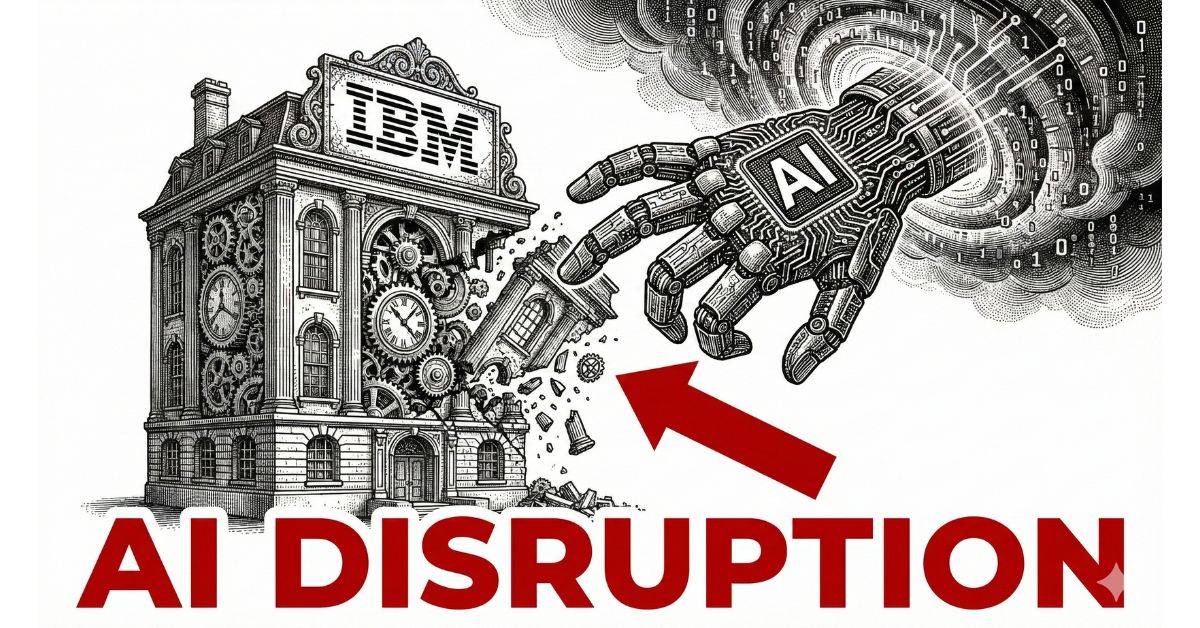
IBM stock just suffered its worst day in 25 years. Anthropic news triggered the crash, but the implications go far beyond one company.
Quick Summary
- IBM stock price plummeted 13.2% in a single day, marking its worst performance since 2000, after Anthropic announced a new AI tool.
- Anthropic news today revealed Claude Code, an AI tool that can modernize COBOL, a 60-year-old programming language powering 95% of US ATM transactions.
- This disruption threatens IBM’s core business model, which relies on expensive maintenance contracts for legacy mainframe systems.
- COBOL modernization used to take years and cost millions, but Anthropic AI can now automate the process in a fraction of the time.
- The “AI scare trade” is accelerating, with investors selling off legacy tech stocks that face existential threats from artificial intelligence.
Anthropic announced that its Claude AI tool can now modernize COBOL, a 66-year-old programming language that still runs 95% of ATM transactions, most airline reservation systems, and critical government infrastructure. And IBM—which built its mainframe empire on COBOL—got caught in the blast radius.
I’ve spent nearly two decades in finance and banking. I’ve watched technology disrupt industries before. But this feels different. This feels like watching the ground shift beneath an entire economic era.
The Short Version: What Actually Happened to IBM Stock?
Let me state this clearly upfront so there’s no confusion:
IBM shares fell 13.2%, closing at $223.35, after Anthropic announced that its Claude Code tool can now modernize COBOL systems at a fraction of the traditional cost. This marked IBM’s worst single-day decline since October 18, 2000, and put the stock on track for its biggest monthly drop since at least 1968.
But here’s what the headlines aren’t telling you: This wasn’t just “AI panic.” This was a precise, targeted strike at the heart of IBM’s business model.
For decades, IBM has made billions maintaining the mainframe computers that run COBOL. Banks, insurance companies, airlines, and government agencies pay IBM enormous sums to keep these ancient systems running because rewriting the code was simply too expensive and too risky.
Anthropic just flipped that equation upside down.
The COBOL Time Bomb: Why 800 Billion Lines of Code Just Became a Liability
Most people outside the tech industry have never heard of COBOL (Common Business-Oriented Language). It was developed in 1959. The people who wrote the original code are mostly retired or deceased. And yet:
- COBOL handles an estimated 95% of ATM transactions in the United States
- Over 800 billion lines of COBOL code run in production every day
- It powers core systems in finance, airlines, insurance, and government
- The average age of a COBOL programmer is between 45 and 55—and shrinking every year
Here’s the problem that’s kept IBM in business for decades: Modernizing COBOL used to require “armies of consultants spending years mapping workflows.” A single modernization project could cost tens of millions of dollars and take three to five years. Most companies simply decided it was cheaper to keep paying IBM to maintain the old systems.
This was IBM’s moat. The complexity created job security. The obscurity created pricing power. The fear of breaking critical systems created customer lock-in that would make SaaS companies weep with envy.
Anthropic just dynamited that moat.
What Anthropic Actually Announced (And Why It’s a Bigger Deal Than You Think)
In its Monday blog post, Anthropic laid out exactly how Claude Code can transform COBOL modernization. And if you’re not in tech, let me translate what this means in plain English:
Before Claude Code: A bank wanting to modernize its core transaction system would need to hire dozens of specialized consultants. These consultants would spend months or years manually mapping dependencies across millions of lines of code. They’d document workflows through interviews with aging employees who understood the system. They’d identify risks through painstaking manual analysis. The whole process was slow, expensive, and error-prone.
With Claude Code: The AI can automate the exploration and analysis phases that consume most of the effort. It can map dependencies across thousands of lines of code in minutes. It can document workflows automatically. It can identify risks that “would take human analysts months to surface.”
Anthropic put it bluntly: “Legacy code modernization stalled for years because understanding legacy code cost more than rewriting it. AI flips that equation.”
Let me repeat that because it’s the most important sentence in this entire article: AI flips that equation.
What was economically impossible becomes economically inevitable. What took years now takes quarters. What required armies now requires a team and a subscription.
Why IBM Stock Got Crushed: Following the Money
To understand why IBM shares dropped 13%, you need to follow the money.
IBM’s mainframe business isn’t some small division. It’s a massive profit center. These aren’t cheap commodity servers—we’re talking about systems that can cost millions of dollars each, plus ongoing maintenance contracts that generate recurring revenue for decades.
Here’s the business model in simple terms:
- Sell the hardware: IBM sells mainframe computers optimized for large-scale transaction processing. A single IBM mainframe can cost anywhere from $100,000 to several million dollars.
- Charge for the software: IBM’s operating systems and software licenses for mainframes generate billions in annual revenue.
- Sell the maintenance: This is the real gold mine. Companies pay IBM annual fees to keep their mainframes running, get updates, and access support.
- Bill for the expertise: When something breaks or needs updating, IBM consultants bill hundreds of dollars per hour.
All of this depends on one thing: Companies believing they have no choice but to keep running COBOL on IBM mainframes.
Anthropic’s announcement directly threatens that assumption. If companies can modernize their COBOL systems in months instead of years, for a fraction of the cost, they suddenly have options. They could potentially migrate to modern cloud infrastructure running modern code. They could break free from the mainframe tax.
Wall Street saw this and did the math. IBM’s mainframe business represents a significant portion of its revenue and an even larger portion of its profits. If AI erodes that business, the entire valuation changes.
The Three Headwinds That Hit IBM on Monday
Here’s what made Monday particularly brutal for IBM stock. It wasn’t just one thing—it was a perfect storm of three distinct pressures:
1. The Anthropic Announcement
The direct hit. Claude Code can now modernize COBOL. This is existential for a chunk of IBM’s business.
2. The Citrini Research Report
Over the weekend, a little-known firm called Citrini Research published a scenario analysis that went viral. It painted a picture of 2028 where AI has caused mass white-collar unemployment, displaced delivery apps with “vibe-coded” alternatives, and eliminated transaction fees for payment processors like Visa and Mastercard.
The report was explicitly labeled as “a scenario, not a prediction.” But in a nervous market, it added fuel to the fire. Investors started connecting dots between AI disruption and their portfolios.
3. Nassim Taleb’s Warning
Nassim Taleb, the author of “The Black Swan,” warned that investors should brace for escalating volatility and even bankruptcies in the software sector. He argued that markets are underpricing structural risks while overestimating the durability of current AI leaders.
When someone with Taleb’s track record warns about fragility, markets pay attention.
These three things hit simultaneously. The Anthropic news provided the specific trigger. The Citrini report provided the scary vision of the future. Taleb’s warning provided the intellectual framework. Together, they created a selling panic that wiped out $20+ billion in IBM market cap in a single day.
The “AI Scare Trade”: Why Software Stocks Keep Getting Hammered
IBM wasn’t alone on Monday. DoorDash fell 6%, American Express dropped 6%, KKR and Blackstone both sank at least 6%, and cybersecurity firms like CrowdStrike and Datadog tumbled.
This is the “AI scare trade” in action, and I’ve been watching it closely since early February.
Here’s how it works:
- An AI company announces a new capability. Anthropic announces a legal plugin. OpenAI releases a better model. Google demonstrates something new.
- Investors immediately ask: “Who does this disrupt?”
- Stocks in the target industry sell off. Sometimes rationally. Sometimes not.
- The selling spreads. Nervous investors adopt a “shoot first, ask questions later” mentality.
What’s different this time is the precision. When Anthropic announced its COBOL modernization tool, the market didn’t sell off “tech stocks” broadly. It specifically targeted IBM. The connection was clear, direct, and devastating.
Michael O’Rourke, chief market strategist at Jonestrading, put it well: “I have seen this market exhibit incredible resilience in the face of actual negative news. Now a literal work of fiction sends it into a tailspin.”
But here’s the thing: Anthropic’s announcement wasn’t fiction. It was real. And it revealed something important about how AI disruption will actually work.
How AI Disruption Is Different This Time
I’ve been investing and working in finance for nearly 20 years. I’ve seen dozens of “disruption” narratives come and go. But this AI cycle feels fundamentally different for three reasons:
Reason 1: The Speed of Capability Expansion
Previous technology cycles moved slowly. The internet took a decade to reach critical mass. Mobile took five to seven years. AI capabilities are expanding monthly, sometimes weekly.
Anthropic’s Claude wasn’t even a household name two years ago. Now it’s announcing tools that threaten a business model that’s stood for half a century. The speed is unprecedented.
Reason 2: The Precision of the Threat
Notice that Anthropic didn’t announce “AI can do everything.” They announced a specific tool for a specific problem: COBOL modernization. This precision makes the threat more credible and more investable.
Companies can now look at their specific technical debt and ask: “Can AI solve this specific problem?” When the answer is yes, the business case for expensive legacy systems collapses.
Reason 3: The Cost Reduction Is Massive
Anthropic’s key insight: “Understanding legacy code cost more than rewriting it.” AI doesn’t just make modernization slightly cheaper. It changes the economic equation from “impossible” to “inevitable.”
When something becomes 10x cheaper and 10x faster, adoption isn’t a question of “if”—it’s a question of “when.”
What This Means for Your Portfolio: The New Rules of AI Investing
If you’re an investor, Monday’s IBM selloff contains important lessons. Here are my rules for navigating the AI disruption era:
Rule 1: Identify the “Moat Businesses”
Every industry has companies whose competitive advantage comes from complexity, obscurity, or lock-in. These are the most vulnerable to AI disruption.
Ask yourself: “What does this company do that would be threatened if understanding complex systems became cheap and easy?”
For IBM, the answer was clear: maintaining incomprehensible legacy code. For credit card companies, it might be transaction processing. For insurance brokers, it might be policy placement. For law firms, it might be document review.
Rule 2: Don’t Confuse Vulnerability with Immediacy
Just because a business is vulnerable doesn’t mean it collapses tomorrow. COBOL modernization will take time. Companies will need to test, validate, and slowly migrate. IBM will have opportunities to adapt and evolve.
The market’s job is to price future cash flows today. That’s why IBM stock dropped 13% immediately—investors are adjusting their long-term expectations, not predicting bankruptcy next quarter.
Rule 3: Watch for Adaptation Signals
The companies that survive AI disruption won’t be the ones that fight it. They’ll be the ones that embrace it.
For IBM, the question is: Can they pivot from “mainframe maintenance” to “AI-powered modernization services”? Can they use Anthropic’s tools themselves to help customers transition? Can they find new sources of value that AI creates rather than destroys?
I’ll be watching IBM’s response closely. How they position themselves in the coming months will tell us whether this is a buying opportunity or the beginning of a long decline.
Rule 4: Diversify Across Disruption Scenarios
One of the hardest things about the “AI scare trade” is that you can’t predict exactly which domino will fall next. The Citrini report imagined AI disrupting food delivery and credit cards. Anthropic actually disrupted mainframe computing.
The solution isn’t to avoid AI-exposed sectors—that’s impossible. The solution is to diversify across different disruption scenarios. Own some companies that might benefit from AI (like Anthropic’s investors). Own some that might be resilient (like essential infrastructure). Own some that might adapt (like forward-thinking legacy companies).
The Bigger Picture: What AI Modernization Means for the Economy
Let’s zoom out for a moment. Because while IBM’s stock drop is dramatic, the broader implications are even more significant.
We’re sitting on decades of accumulated technical debt. Millions of lines of code written in languages that fewer and fewer people understand. Systems held together by knowledge that’s walking out the door as the Baby Boomer generation retires. Critical infrastructure running on technology that predates the internet.
The traditional solution was to let it run until it breaks, then pay whatever it costs to fix it. That was the IBM business model in a nutshell.
AI changes this entirely. For the first time, we have a realistic path to modernizing the hidden infrastructure that runs the modern world.
Think about what this could mean:
- Banks could finally migrate off mainframes onto modern, cloud-native systems that enable faster innovation and better customer experiences
- Government systems could become more secure and maintainable, reducing the risk of catastrophic failures
- Airlines could modernize reservation systems that currently run on code written before most of their passengers were born
- Insurance companies could unlock decades of data currently trapped in legacy formats
This isn’t just about saving money on maintenance. It’s about enabling innovation that’s currently impossible because the underlying systems are too fragile to touch.
The Risks Nobody’s Talking About
Of course, every transformation comes with risks. And the AI-driven modernization of critical infrastructure raises serious questions:
Risk 1: Moving Too Fast
When you’re dealing with systems that handle money, flights, or government services, reliability isn’t optional. Rushing modernization could create catastrophic failures.
Risk 2: Losing Institutional Knowledge
There’s value in the people who understand these systems—even if that understanding is expensive. If we automate away the need for COBOL programmers, we also lose the context and judgment they bring.
Risk 3: Creating New Technical Debt
Modernizing legacy code with AI assistance could create new code that’s just as difficult to maintain—just in different ways. We need to ensure we’re not trading one form of technical debt for another.
Risk 4: Concentration of Power
If a small number of AI companies control the tools for modernizing critical infrastructure, we create new dependencies and new single points of failure.
These risks don’t mean we shouldn’t proceed. They mean we should proceed thoughtfully, with eyes wide open.
The Three Lenses: How to Think About AI Disruption
After Monday’s events, I’ve been thinking about three different ways to view what’s happening. Each lens reveals something different:
Lens 1: The Investor Lens
What happened: IBM lost $20+ billion in market cap because an AI company announced a tool that threatens its mainframe business.
What it means: The market is now pricing AI disruption into stock valuations in real-time. This will create volatility and opportunity for years to come.
Advice: Reassess your portfolio for “complexity moats.” Identify companies whose competitive advantage depends on things being hard to understand or expensive to change. Those are the most vulnerable.
Lens 2: The Business Leader Lens
What happened: A 66-year-old programming language just became modernizable at a fraction of the previous cost.
What it means: Technical debt is no longer a permanent condition. The economics of legacy systems have fundamentally changed.
Advice: Start planning your modernization journey now. The companies that move first will gain competitive advantage. The ones that wait will be disrupted.
Lens 3: The Economic Lens
What happened: Critical infrastructure that was previously “too hard to touch” just became accessible.
What it means: We may be on the cusp of a wave of modernization that unlocks productivity and innovation across multiple sectors.
Advice: Watch for investment opportunities in companies that enable or benefit from this modernization wave—cloud providers, AI companies, modern software platforms.
What I’m Watching Next
As someone who’s been through multiple market cycles and technology shifts, here’s what I’ll be watching in the coming weeks and months:
1. IBM’s response. How does the company position itself? Do they embrace AI-powered modernization or fight it? Do they announce partnerships with AI companies or try to build competing tools?
2. Other legacy tech companies. If AI can disrupt IBM’s mainframe business, what about other companies built on complexity? I’m watching Oracle, SAP, and legacy enterprise software providers.
3. Adoption by major banks. When will the first major bank announce a COBOL modernization project using AI? That announcement will trigger the next wave of selling—or validate the opportunity.
4. Anthropic’s next move. What other legacy systems will Claude target? Each announcement will create new winners and losers.
5. The regulatory response. Governments rely on COBOL systems too. How will they approach modernization? Will they lead or follow?
The Bottom Line: A New Chapter Begins
Let me bring this back to where we started.
IBM stock didn’t drop 13% because of vague “AI fears.” It dropped because a specific AI tool demonstrated the ability to solve a specific problem that has protected IBM’s business for decades.
This is what disruption looks like when it’s real. Not hand-waving about the future. Not abstract threats. A concrete announcement that changes the economic calculation for thousands of customers.
For investors, the lesson is clear: Pay attention to specific capabilities, not general narratives. When an AI company announces it can do something that was previously impossible or prohibitively expensive, follow the money. Ask who loses. Ask who wins. Ask what changes.
For business leaders, the message is equally clear: The cost of waiting just went up. Every month you delay modernization is a month your competitors might be using AI to leapfrog you. The tools exist. The economics work. The only question is whether you’ll act.
And for the rest of us—the customers, citizens, and workers who depend on the systems AI is about to transform—we’re watching history happen in real-time. The infrastructure that’s quietly powered the global economy for half a century is about to get an upgrade.
It won’t happen overnight. It won’t be smooth or simple. But it’s happening.
And on Monday, IBM stock told us that the market finally understands.
My Advice: What to Do Right Now
If You’re an Investor:
- Review your portfolio for companies with “complexity moats.” Make a list of businesses whose competitive advantage depends on things being hard to understand or expensive to change.
- Assess their vulnerability. Could AI make their core competency cheap and easy? If so, how quickly?
- Diversify across disruption scenarios. Don’t bet everything on one outcome.
- Set price alerts for AI announcements in your vulnerable holdings. The market reacts fast—you need to be ready.
If You’re a Business Leader:
- Audit your technical debt. Create an inventory of legacy systems, their costs, and their risks.
- Run an AI pilot. Pick a small, non-critical legacy system and try modernizing it with AI assistance. Learn what works.
- Calculate the new economics. Re-run the ROI on modernization with AI-powered tools. The answer may surprise you.
- Build a transition plan. Start mapping the path from legacy to modern. It will take years, so start now.
If You’re a Tech Professional:
- Learn how AI tools like Claude Code work. This isn’t coming for your job—it’s coming for the boring parts of your job. The professionals who thrive will be the ones who learn to leverage these tools.
- Specialize in the human elements. AI can analyze code, but it can’t understand business context, build relationships, or make strategic judgments. Double down on these skills.
- Watch the COBOL space. If modernization accelerates, there will be enormous demand for people who understand both the old systems and the new tools.
Final Thoughts
I started my career in finance. I’ve worked through the housing bubble, the COVID crash, and now the AI revolution. If there’s one thing I’ve learned, it’s this:
The biggest risks are never the ones everyone’s talking about.
In 2007, everyone worried about subprime mortgages. The real crisis was in instruments nobody understood.
In 2020, everyone worried about the virus. The real economic damage came from the response to it.
Today, everyone’s worried about AI taking jobs. The real disruption may come from AI quietly modernizing the hidden systems we all depend on—and the companies that built their business models on those systems being too hard to change.
IBM’s 13% drop isn’t the story. It’s a symptom of the story. The story is that complexity just got cheap. Obscurity just got exposed. The old ways of protecting business models just stopped working.
The question isn’t whether this transformation will happen. It’s whether you’ll be ready when it comes for your industry.
Warren Buffett once said the best investment you can make is in your own understanding. That advice has never been more relevant.
IBM stock didn’t crash because of bad management or weak earnings. It crashed because the market finally caught up to a simple truth: when AI makes complexity cheap, the companies that charged premium prices for complexity lose their power.
That truth isn’t limited to IBM. It’s coming for every industry that built its moat out of things that are hard to understand, slow to change, or expensive to maintain.
The Anthropic news cycle is your early warning system. Every announcement points to the next domino. Legal tech. Cybersecurity. Mainframe computing. Ask yourself: what industry is next?
Don’t wait for the crash to start paying attention. Audit your portfolio. Identify your exposure. Find where the value lands when disruption hits.
The AI revolution isn’t coming. It’s already repricing your investments in real time.
I’ve been writing about these trends in my newsletter at TheFinanceNewsletter.com and discussing them on social media (@FluentInFinance).
Summary Table: Key Concepts
| Concept | What It Is | Why It Matters | Who’s Affected | Action to Take |
|---|---|---|---|---|
| COBOL | 66-year-old programming language running critical systems | Handles 95% of ATM transactions, hundreds of billions of lines of code | Banks, airlines, government, IBM | Audit legacy systems; calculate modernization costs |
| Claude Code | Anthropic’s AI tool that can now modernize COBOL | Makes what was impossible affordable and fast | IBM, mainframe consultants, legacy tech | Subscribe to Anthropic announcements; run pilot projects |
| IBM Stock Drop | 13.2% single-day plunge, worst since 2000 | Market repricing IBM’s mainframe business model | IBM investors, tech sector | Review portfolio for “complexity moat” companies |
| AI Scare Trade | Pattern where AI announcements trigger sector sell-offs | Creates volatility and opportunity | Software stocks, tech investors | Set price alerts; identify beneficiaries of disruption |
| Citrini Report | Viral scenario analysis of AI disruption in 2028 | Fueled panic selling; highlighted long-term risks | Delivery apps, payment processors, white-collar workers | Distinguish scenarios from predictions; don’t panic-trade |
| Nassim Taleb Warning | Risk expert warns of software sector fragility | Added intellectual weight to market fears | Software investors | Consider tail risks; diversify portfolios |
| Complexity Moat | Business advantage from being hard to understand or change | Previously protected companies from competition | IBM, legal tech, insurance underwriting, tax prep | Identify vulnerable holdings; assess AI threat |
| Technical Debt | Accumulated cost of postponing system modernization | Now cheaper to fix with AI; waiting is riskier | Companies with legacy infrastructure | Inventory technical debt; plan modernization |
| Vibe Coding | AI generating applications from natural language | Threatens traditional software development | Software companies, developers | Learn AI tools; specialize in human elements |
Frequently Asked Questions About IBM Stock and Anthropic AI
Why did IBM stock drop 13% recently?
IBM stock plunged 13.2% after Anthropic announced that its Claude Code AI tool can now modernize COBOL programming systems. This is a direct threat to IBM’s mainframe business, which generates billions maintaining the COBOL code that runs on its hardware. The market realized that companies may no longer need IBM’s expensive consultants and maintenance contracts if AI can modernize their legacy systems faster and cheaper.
What is COBOL and why does it matter?
COBOL stands for Common Business-Oriented Language. It’s a programming language developed in 1959 that still runs critical infrastructure today. COBOL handles an estimated 95% of ATM transactions in the United States and powers banking, insurance, airline, and government systems. Over 800 billion lines of COBOL code still run in production daily, mostly on IBM mainframes. Its age and complexity made it expensive to modernize—until now.
What did Anthropic announce about COBOL?
Anthropic announced that its Claude Code AI tool can now automate COBOL modernization. The tool can map dependencies across thousands of lines of code, document workflows, and identify risks that would take human analysts months to surface. Anthropic stated: “Legacy code modernization stalled for years because understanding legacy code cost more than rewriting it. AI flips that equation.”
Is IBM stock a buy or sell after the drop?
I can’t give personalized investment advice, but here’s what to consider: IBM shares now trade at a lower valuation, but the underlying business faces structural pressure. The market is pricing in long-term risk to IBM’s mainframe revenue. Watch how IBM responds—if they embrace AI-powered modernization rather than fighting it, they could adapt. If they resist, the headwinds may continue. Always do your own research and consider your risk tolerance.
What other stocks are at risk from AI disruption?
Companies with “complexity moats” are most vulnerable. This includes businesses that charge premium prices because their work is hard to understand or change. Watch: legal tech companies, insurance underwriters, tax preparation firms, procurement consultants, and legacy enterprise software providers like Oracle and SAP. The “AI scare trade” has already hit cybersecurity firms like CrowdStrike and Datadog after Anthropic’s previous announcements.
How long will it take for COBOL to be replaced?
Modernization won’t happen overnight. Banks and government agencies move slowly because reliability is critical. But Anthropic’s tool compresses timelines from years to quarters. The first major bank to announce an AI-powered COBOL modernization project will signal that the transition is real. Expect the process to unfold over 3-7 years, not decades.
What is the “AI scare trade”?
The “AI scare trade” refers to the pattern where AI company announcements trigger sell-offs in specific sectors. Investors immediately ask “who does this disrupt?” and sell first, ask questions later. The pattern started with Anthropic’s legal plugins hitting legal tech, then its security tools hitting cybersecurity, and now its COBOL modernization hitting IBM. Each announcement creates volatility.
Who was Nassim Taleb and what did he say?
Nassim Taleb is the author of “The Black Swan” and a renowned risk expert. He warned that investors should brace for escalating volatility and even bankruptcies in the software sector. Taleb argues that markets are underpricing structural risks while overestimating how durable today’s AI winners will be. His warning added intellectual weight to the selling pressure on IBM and other tech stocks.
What was the Citrini Research report?
Citrini Research, founded by James van Geelen, published a viral scenario analysis set in 2028. It painted a picture where AI causes mass white-collar unemployment, displaces delivery apps with “vibe-coded” alternatives, and eliminates transaction fees for payment processors. The report explicitly labeled itself “a scenario, not a prediction,” but it fueled panic selling by helping investors imagine worst-case outcomes.
How can investors protect themselves from AI disruption?
Audit your portfolio for “complexity moat” businesses. Ask: “Could AI make this company’s core competency cheap and easy?” Diversify across disruption scenarios—own some AI beneficiaries, some resilient companies, and some that might adapt. Don’t panic-sell on headlines, but don’t ignore structural threats. Set price alerts for vulnerable holdings and watch Anthropic’s announcements closely.
What should business leaders do about legacy systems?
Act now. Audit your technical debt—create an inventory of legacy systems, their costs, and their risks. Run an AI pilot project on a small, non-critical system to learn what works. Recalculate modernization ROI with AI-powered tools; the math probably changed. Build a transition plan even if execution takes years. The cost of waiting just went up.
What is “vibe coding”?
Vibe coding refers to AI systems that can generate functional applications from natural language descriptions. You describe what you want, and the AI builds it—no coding required. This concept, mentioned in the Citrini report, threatens traditional software development. If business users can create their own apps by describing needs to AI, demand for traditional software and developers could shrink.
How does Claude Code actually work?
Claude Code uses AI to automate the exploration and analysis phases of COBOL modernization. It can map dependencies across thousands of lines of code in minutes, document workflows automatically, and identify risks that would take humans months to find. Instead of armies of consultants spending years understanding legacy code, a small team with Claude Code can do it in quarters.
Will IBM recover from this drop?
IBM has survived disruptions before. The company pivoted from hardware to services, then from services to cloud. They still have enormous relationships with Fortune 500 companies and government agencies. Whether IBM recovers depends on their response. If they embrace AI-powered modernization and help customers transition, they could find new revenue streams. If they fight the change, the headwinds will persist.
What does this mean for banks and ATM users?
In the short term: nothing changes. Your ATM still works. But in the long term, banks may finally modernize core systems that currently run on COBOL. This could mean faster innovation, better mobile apps, and lower costs as banks move off expensive mainframe infrastructure. The transition will be invisible to customers but transformative behind the scenes.
How can tech professionals prepare for AI disruption?
Learn AI tools immediately. Spend time understanding how Claude Code and similar tools work. Specialize in human elements that AI can’t replace—business context, strategic judgment, relationship building. Watch the COBOL modernization space; if it accelerates, there will be huge demand for people who understand both old systems and new tools.
What is Anthropic’s broader strategy?
Anthropic appears to be systematically building an “application layer” on top of its Claude language model. Instead of just a general-purpose AI, they’re creating specific tools for specific industries: legal plugins for legal tech, security tools for cybersecurity, COBOL modernization for legacy enterprise. Each tool targets an established industry’s revenue model with surgical precision.
Could this happen to other legacy tech companies?
Yes. If AI can modernize COBOL, it can likely modernize other legacy systems. Watch companies like Oracle, SAP, and legacy enterprise software providers. Any business that built a moat around complexity, obscurity, or lock-in is vulnerable. The question isn’t if AI will come for them, but when.
What’s the one thing everyone gets wrong about AI disruption?
Most people assume disruption takes years or decades. They point out that legacy systems are entrenched and can’t change overnight. What they miss is that the market prices future cash flows today. IBM’s stock dropped 13% not because COBOL will disappear tomorrow, but because the long-term economics just shifted. The market sees the end state and adjusts prices immediately, even if the transition takes time.
Where can I follow AI disruption news?
Subscribe to Anthropic’s official blog for their announcements. Follow TheFinanceNewsletter.com for market analysis. Connect on social media (@FluentInFinance) for real-time updates. Watch for patterns—each Anthropic announcement targets a specific industry, creating both risks and opportunities.

Leave a Reply